Roomies
A single home for the work of living with other people: chores, shared costs, calendars, files, and messages, added only when a group needs them.
- Role
- Product design
- Type
- Group project
- Status
- Prototype
- Timeline
- 2022
Overview
Roomies came out of four years of roommates at the University of Central Florida. Shared schedules, chores, cost splitting, reminders, documents, and to-do lists each already had an app. Roommate matching had apps too. The missing piece was one place that held the tools people need once they are actually living together.
The product is a mobile and web app organized around a home. Someone creates a space, adds their roommates, and keeps the day-to-day of that home in one dashboard: who bought the sofa, who mowed the lawn, when rent is due, what still needs doing. I designed the prototype with Ryan Pattillo and Tim Yang.
Screenshot 1 of 5
Centralized, on purpose
The tools themselves are familiar. Chore lists, calendars, messaging, and bill splitting already exist on their own. Roomies is the decision to put them in one home, and to make that home easy enough that roommates keep using it while they live together.
College students were the first audience, starting at UCF. Building it there meant a large campus to learn from: which problems were actually shared, and which modules a home needed before the list was treated as final.
A dashboard the group assembles
A home is a group with a customizable dashboard. People invite the others who live there and add components as the situation asks for them. The platform comes first. Modules follow one at a time, so a dorm floor, a four-person apartment, and a smaller crew can each end up with a different set of tools. The same shell could hold other kinds of groups later. The roommate home was the one this prototype was built to test.
The screens walk through that model:
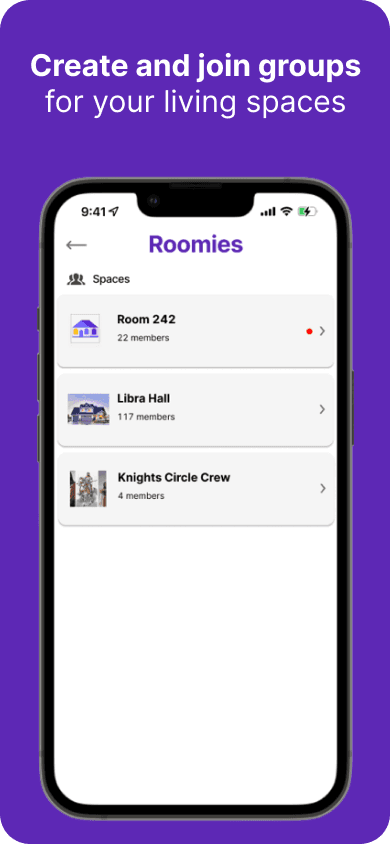
- Spaces. A person can belong to more than one group — a room, a residence hall, a smaller crew — and move between them.
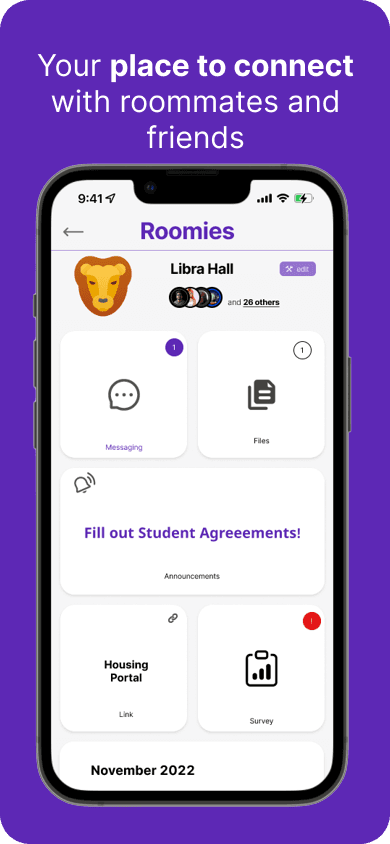
- The home. Messaging, files, announcements, links, and surveys sit together on that space’s dashboard.
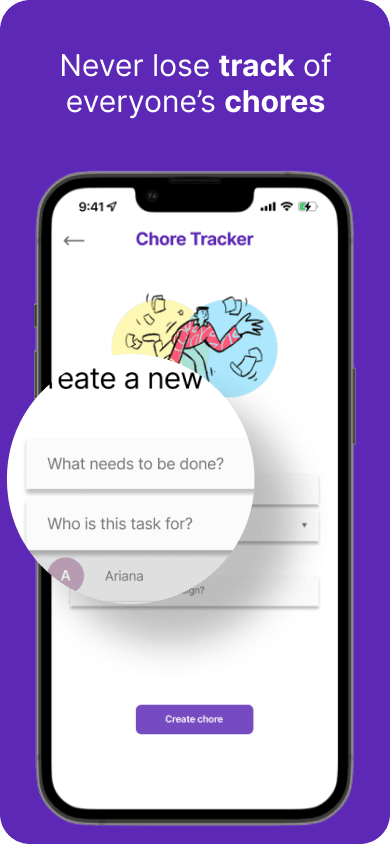
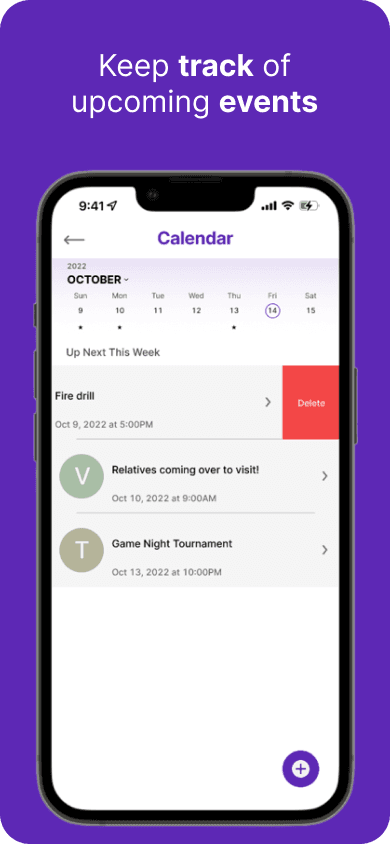
- Chores and the calendar. A task names what needs doing and who it is for. The week’s events stay visible, including the ones someone can dismiss.
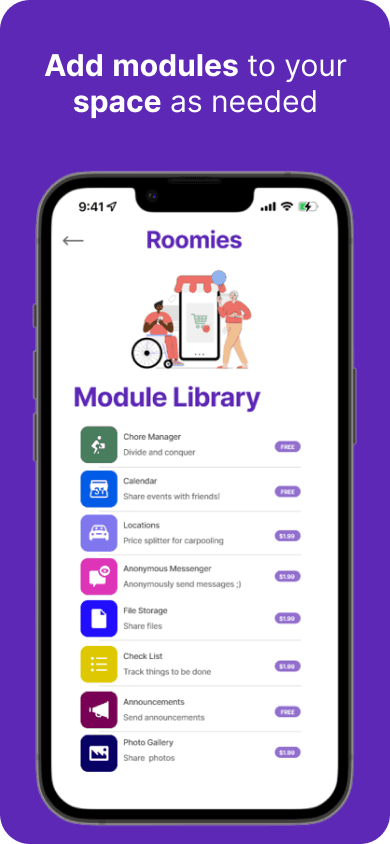
- The module library. Chore manager, calendar, locations and price splitting, messaging, file storage, checklists, announcements, and a photo gallery can be added to a space. The library treats some of those as part of the base home and others as paid add-ons.
That library is also the longer idea in the original concept. Keep a home modular enough that a group designs it around a real use case, then let premium components extend it — including, eventually, components made by other people, closer to Discord bots than a fixed feature menu.
What the prototype was for
The concept stayed open on purpose. Market research still had to answer how someone would build their dashboard, and which components they would actually add. The prototype was the artifact for that conversation: a roommate home concrete enough to react to, with the module list still able to change once students said what they struggled with.